
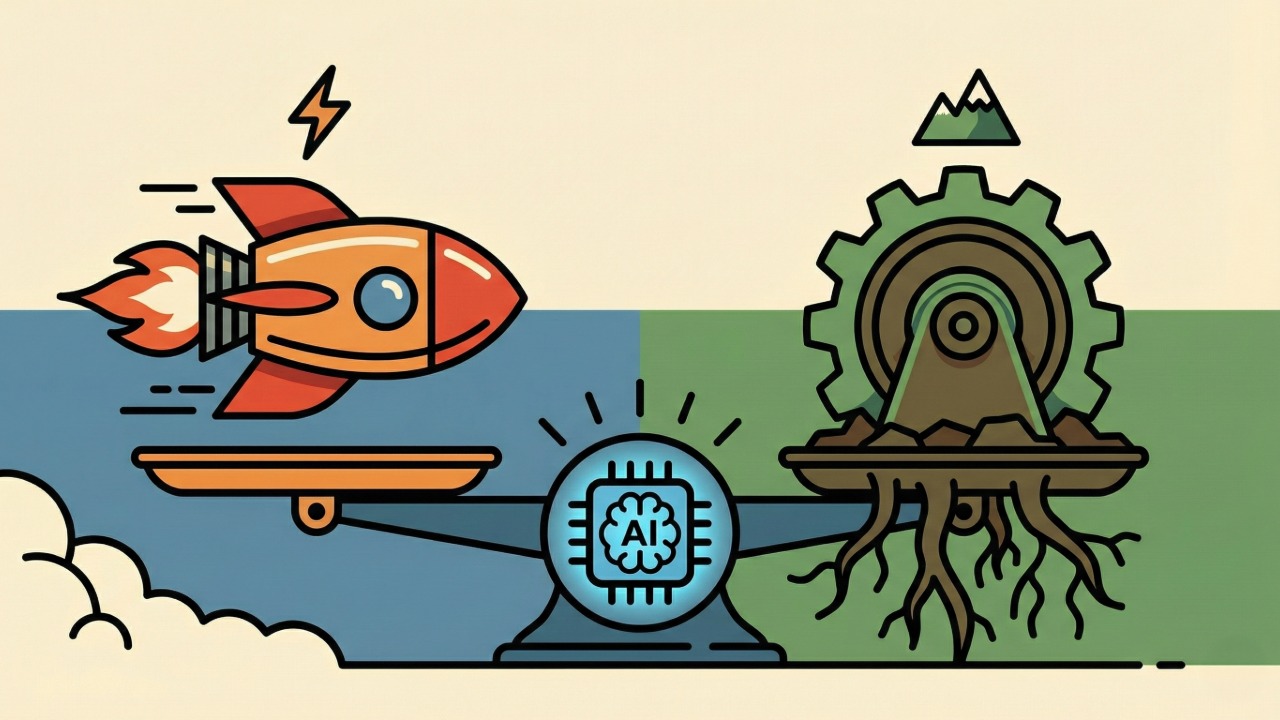
Every few months I hear the same question from founders:
“Should I build in Europe or move to the US?”
People often talk about it like it has to be one or the other. Like choosing a place automatically makes you a certain kind of founder.
After a few startups, I see it more simply.
This is not about which place is “better”.
It is about tradeoffs. And those tradeoffs shape your company in ways you only notice once you are deep into it.
If you are building AI or deep tech, that part matters a lot.
The story that made this real for me
One of my previous startups was basically “git for design”.
This was before the AI era, but it was still deep tech.
A lot of C++. A lot of complex systems work. The kind where you cannot hide behind demos. Either the engine works, or it does not.
It took us two years just to get to an MVP.
Two years is a long time to keep a team motivated when you do not have a clean product story yet.
You do not even fully know who the exact user is. You are still validating the problem while building the core technology.
And here is the part that matters:
The team did not change.
Not once. Not because everything was going great, but because we stayed and built.
That experience rewired how I think about “Europe vs US”.
Because when your product needs years to mature, the question is not just “where is the best talent”.
The question is:
Where do you find the kind of team, culture, and tempo that can survive the boring years?
The US advantage: speed, capital, density
The US has real, unfair advantages. Nobody should pretend otherwise.
If you are in the right circles, things move fast:
- Capital is deeper and decisions can be quicker.
- You are surrounded by people who have scaled companies before.
- Ambition is normal. “We want to be huge” is not cringe. It is expected.
If your company wins by moving first, raising fast, hiring fast, and capturing distribution early, the US can be the best place to play.
But speed has a price.
Talent is expensive.
Churn is normalized.
People optimize for upside, and they have a lot of options.
If things look shaky for a couple of quarters, you can feel the room get quieter.
Not because anyone is evil. That’s just how that market works.
The Europe advantage: endurance, cost efficiency, loyalty
Europe looks weaker on paper if you focus only on capital and growth-stage hype.
But it has a different set of strengths:
- Top talent is often significantly cheaper for the same level of skill.
- People tend to stay longer and build with you.
- Teams are used to being lean by default.
And that last one matters more than it sounds.
In Europe, you are often forced into a style of company-building where you cannot rely on money to solve every problem. You learn to iterate. You learn to survive. You learn to keep going when the story is not perfect yet.
That is not always fun.
But for deep tech, it can be exactly what you need.
Same skill, different game
I don’t buy the “Europe has worse engineers” story.
The best people in Europe are just as strong as the best people in the US.
The difference I keep seeing is the default mindset around time.
In the US, a lot of the system rewards speed: raise faster, hire faster, grow faster.
In Europe, the system rewards endurance: stay lean, iterate longer, survive long enough to get it right.
Neither is morally better.
They are just different environments that shape behavior.
Why this matters for AI and deep tech
Deep tech progress often looks slow from the outside.
It’s long stretches of invisible work.
Experiments that fail quietly.
Infrastructure and data problems that take months.
Customer discovery that moves slower than you want.
My “git for design” startup taught me that the hardest part was not the code.
The hardest part was staying calm for two years while we were still figuring out what we truly were.
When you are in that phase, team stability is not a nice-to-have.
It is the foundation.
This is where Europe can be a great fit, because loyalty and patience are more common.
This is also where the US can be brutal, because people have more options and speed expectations are higher.
At the same time, the US can be the right answer if your deep tech requires huge early capital, access to specific talent clusters, or enterprise distribution that is simply easier there.
So again: tradeoffs.
How I’d decide today
I would start with questions:
Do we need big money early, or can we start lean?
Is our edge mostly technical, or mostly distribution?
Will this take years before it looks obvious?
Do we need dense go-to-market experience right away?
If the answer is speed and distribution, the US helps.
If the answer is long iteration and stability, Europe can be a strong base.
The answer that often works: hybrid
A pattern that keeps making sense, especially for AI founders:
Build the core team where you can get endurance.
Be close to the market where you need reach.
For many teams that means building the core in Europe, and being close to US customers and capital when it matters.
You get the best of both worlds if you can handle the complexity.
Not every company can.
But when it works, it is a serious advantage.
So, Europe or the US?
If you are building AI or deep tech, your timeline matters.
My only strong opinion is this:
Do not pick based on vibes.
Pick based on the kind of company you are actually building.
Because some companies need to win fast.
And some companies just need to survive long enough to get it right.
Would you build in Europe, the US, or try to do both?

