
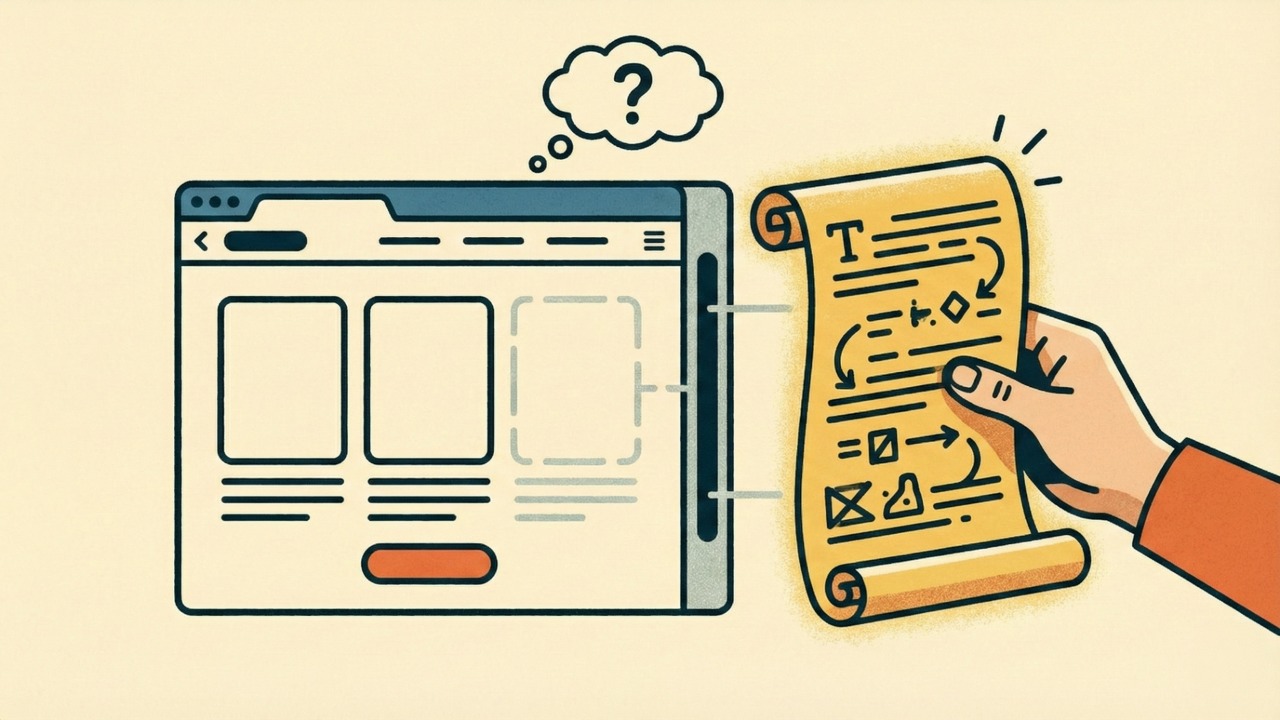
Most developer-led products look fine at first glance.
There is a clean nav bar.
Some cards in the middle.
A primary button in the corner.
Nothing is ugly. Nothing is obviously broken. You have a design system, consistent spacing and decent typography. From a distance, it passes as “good design”.
But every time I look at these products with a founder, the same thing is missing.
I can’t see who this is really for.
I can’t see what actually changes in their week.
I can’t see one simple line that connects the homepage, the product screen and the deck.
The problem is not the pixels.
The problem is the story underneath them.
I learned this the hard way. I used to obsess over details: colors, icons, states, tiny layout tweaks. I thought I had a design problem. What I really had was a fuzzy story that leaked into everything.
When I build design kits for startups now, I am basically trying to make three things brutally clear at the same time:
- The homepage says who this is for in one breath.
- The product screens show how work actually changes.
- The deck connects those two with a simple narrative.
Only after that do I care about “nice” details.
If you cannot say, in one breath, who you built this for and what changes in their world, your homepage will fall back to safe nonsense like “all-in-one platform for modern teams”. Your product UI will be full of fake data that looks like a component library demo. Your deck will be a random walk from problem slide to roadmap slide without a real before and after.
From the outside, people call this a design issue.
Most of the time, it is not.
It is a story issue that shows up as vague copy, generic screens and forgettable slides.
If this feels a bit close to home, don’t open Figma first.
Write one honest sentence:
“I built this for X, in situation Y, so that Z in their week changes.”
Make that sentence drive your homepage.
Make your UI look like a screenshot from that situation.
Make your deck just a slightly slower version of that same story.
Your UI is probably fine.
Your story isn’t.
Start there.

